
CASE STUDY
Zuora NextGen CPQ
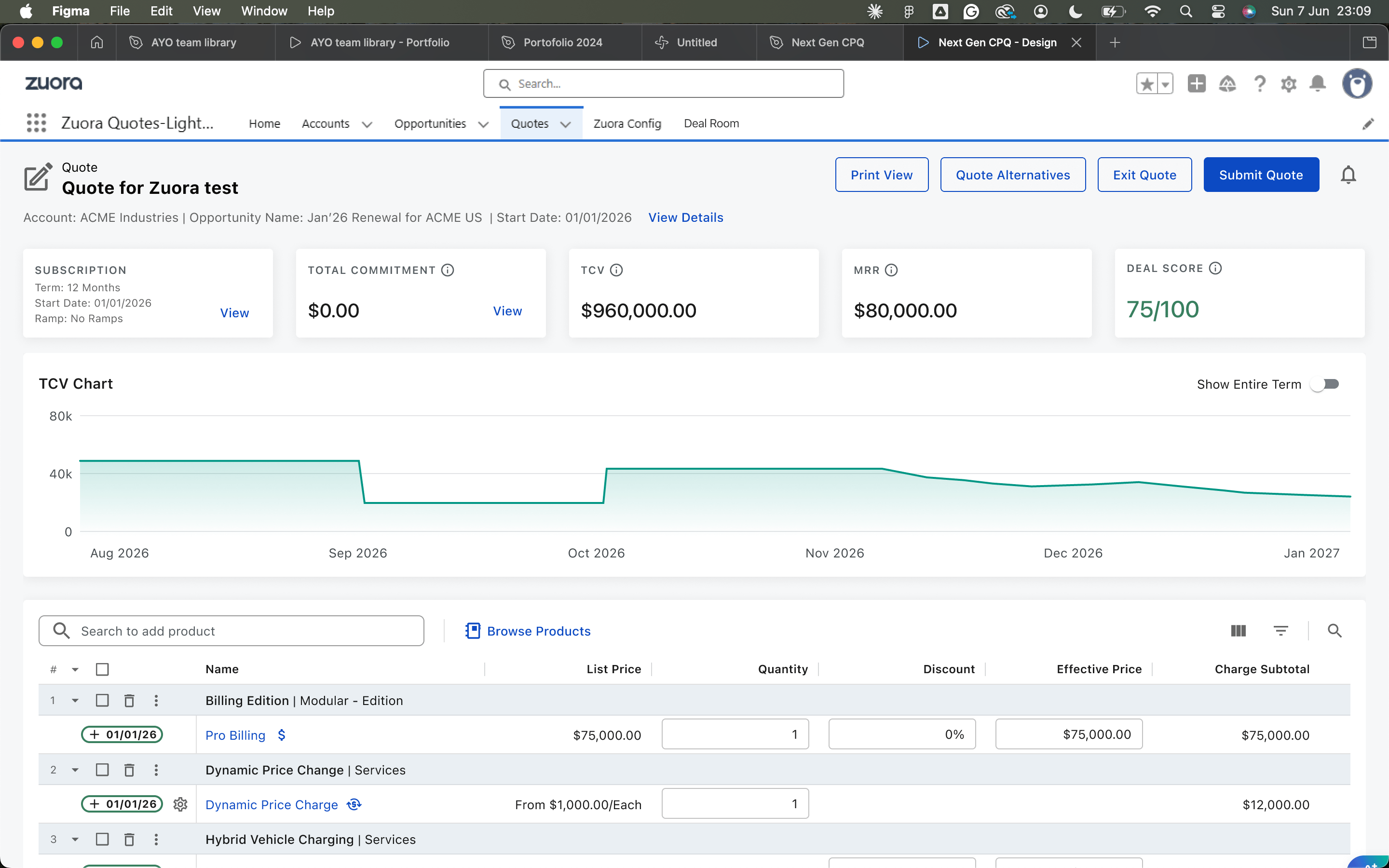
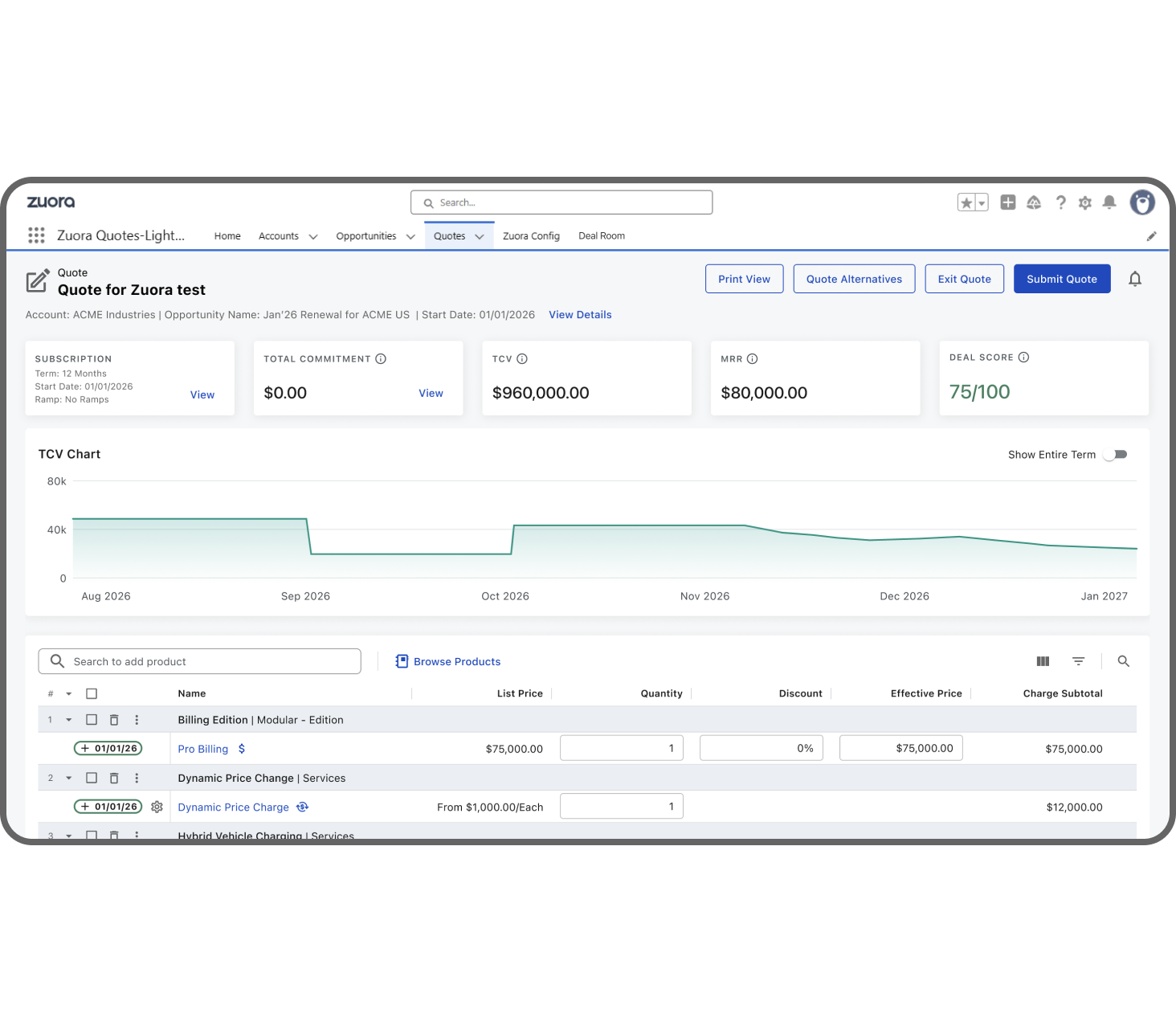
As subscription businesses scale, quoting becomes increasingly complex. Sales teams must configure products, apply pricing rules, manage amendments, and generate accurate quotes while working under time pressure. Zuora NextGen CPQ focused on reducing that complexity by making enterprise quoting easier to understand, faster to complete, and less prone to costly configuration errors.
01 — OVERVIEW
Problem statement & context
Enterprise quoting in Zuora CPQ becomes difficult when scale, time-based changes, and policy complexity intersect. Sellers often manage large, multi-dimensional quotes across ramps, locations, billing accounts, amendments, and future-dated changes. The existing experience exposed this complexity all at once, making quotes difficult to scan, review, and confidently maintain.
This was not just a usability problem. It was a workflow and revenue problem. When quote construction feels dense, slow, or unclear, sellers spend more time navigating the tool, errors become harder to catch, and confidence drops during high-stakes deal work.
Challenge: How might we help sellers understand complex enterprise deals, act on the right information at the right time, and create accurate quotes with greater speed and confidence?
Role: Sole product designer
Team: Product manager, engineering lead, three engineers, and product design support
Timeline: 12 months, planned for Q4 2026 release
02 — DISCOVERY
Understanding the problem space
I began by reviewing recorded customer feedback, support themes, and internal sales pain points using Glean. These inputs helped identify recurring friction across the quoting workflow and shaped the focus areas for user interviews.I then conducted interviews with both Zuora sales reps and customer sales reps to validate assumptions, understand how quoting complexity showed up in real deal work, and define which problems were most critical for the first release.
03 — Synthesis & insights
What we learned
Enterprise quoting breaks down when sellers are asked to manage scale, timing, and policy complexity without enough structure or guidance. Some customers work with hundreds or thousands of quote lines, and that complexity increases further when deals include ramps, multiple locations, or different billing accounts.
At the same time, quote lines contain many fields that are important for billing, provisioning, and compliance, but not always meaningful to the seller during active deal construction. This created a gap between what the system needed and what sellers needed to make progress confidently.
KEY INSIGHT 1
Large quotes become harder to review and maintain when visibility does not scale with quote complexity.
KEY INSIGHT 2
Sellers are exposed to billing-critical fields and system states that are necessary for downstream accuracy but noisy during the selling workflow.
KEY INSIGHT 3
Slow performance and fragile save behavior reduce trust, especially when sellers are working on active deals.
KEY INSIGHT 4
Without stronger guardrails and contextual guidance, sellers can move through invalid or incomplete quoting paths and only discover issues later in the process.
04 — IDEATION & EXPLORATION
How we explored the solution space
To avoid designing around every edge case too early, I started with the simplest quoting scenario: a seller creating a quote for a single product. This helped isolate the core workflow, identify the minimum steps required to complete a quote, and evaluate which interaction patterns could scale.
From there, I gradually introduced more complex scenarios, including product bundles, pricing adjustments, approvals, multiple contracts, and high-attribute product configuration. This incremental approach helped the team test the foundation early while ensuring the experience could support enterprise complexity over time.
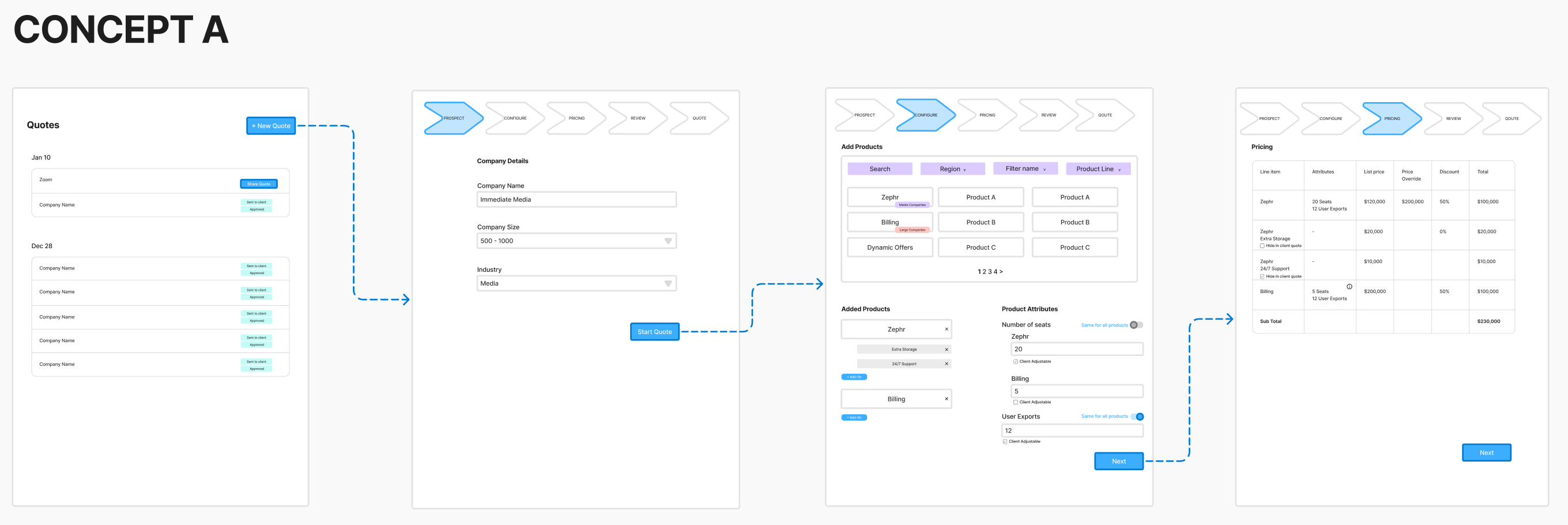
Concept A — Guided stepperThis concept moved sellers through distinct stages: product selection, configuration, pricing, and quote review. A persistent sidebar kept the quote total visible throughout the flow, helping sellers stay oriented while completing more structured tasks.
I moved this concept forward because it provided stronger guidance for complex products, reduced the risk of missed steps, and created clearer opportunities to introduce validation, approvals, and contextual assistance.
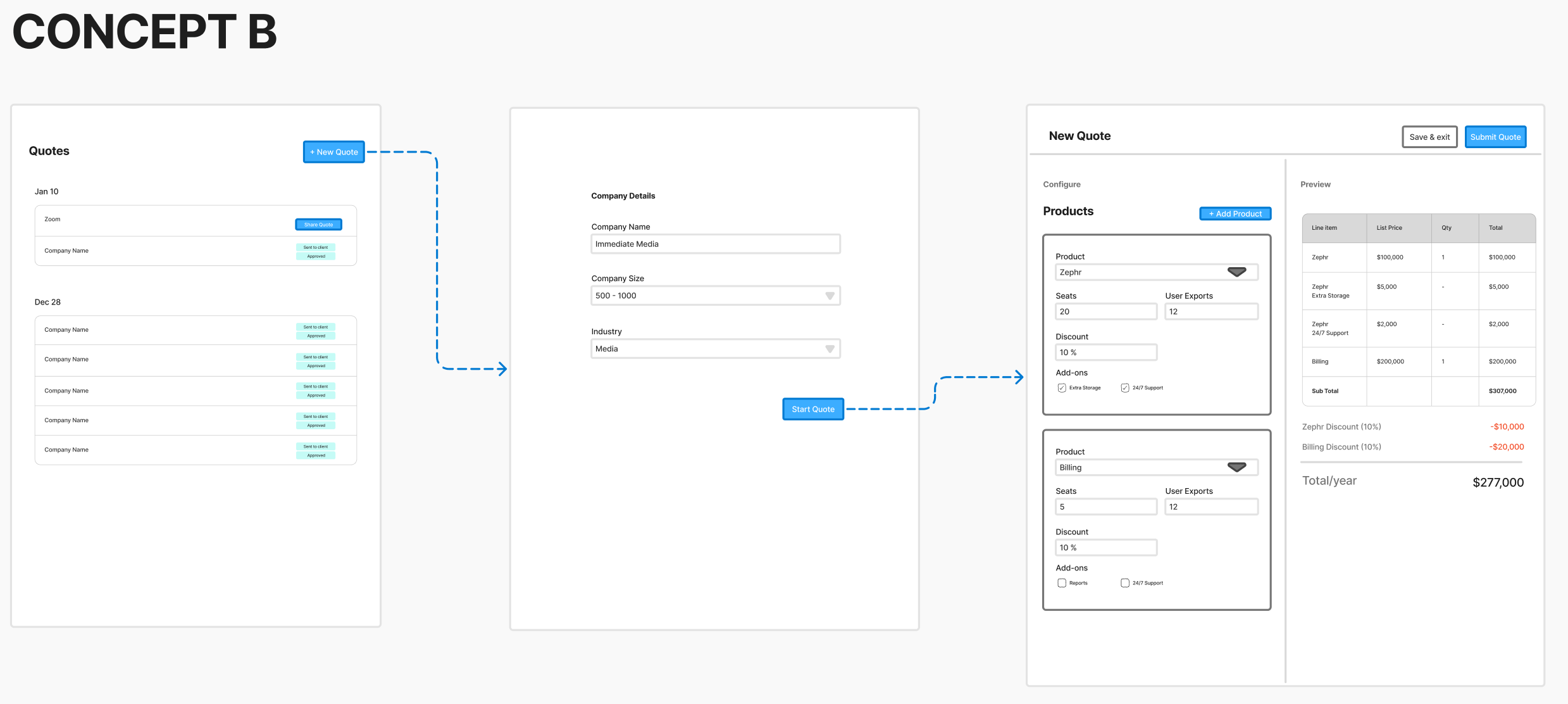
Concept B — Single-canvas split view
This concept placed product configuration and the live quote side by side on one screen. It supported faster editing because sellers could make changes and immediately see the quote update.While this approach worked well for simpler product catalogs, it became harder to scale for complex products with many attributes, pricing rules, and approval requirements. The team decided it was better suited for lower-complexity workflows than the first release experience.
05 — Prototyping & iteration
How designs evolved through testing
Early prototypes focused on product selection, attribute assignment, pricing guidance, approvals, and multi-contract quoting. Each round of testing helped reveal where the experience needed more structure, more visibility, or more assistance.
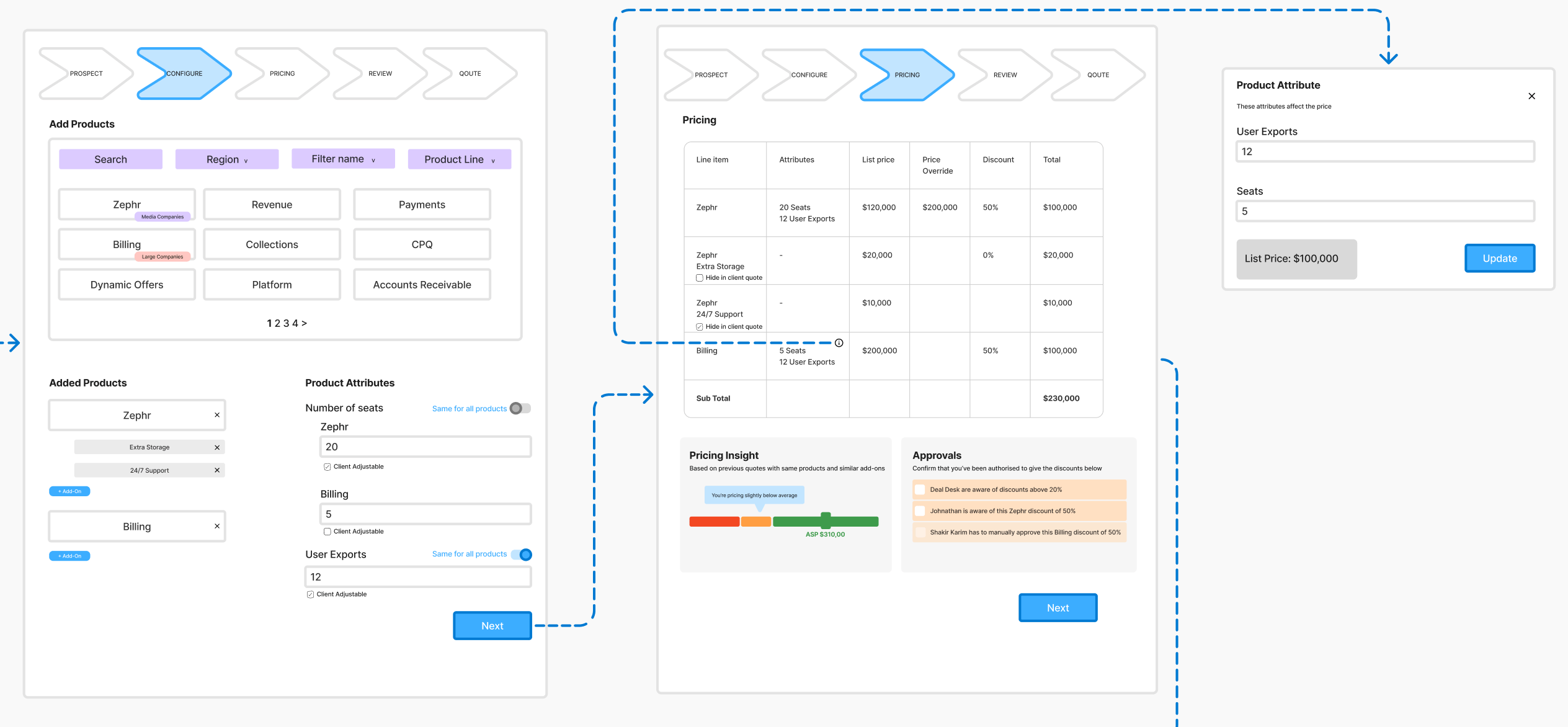
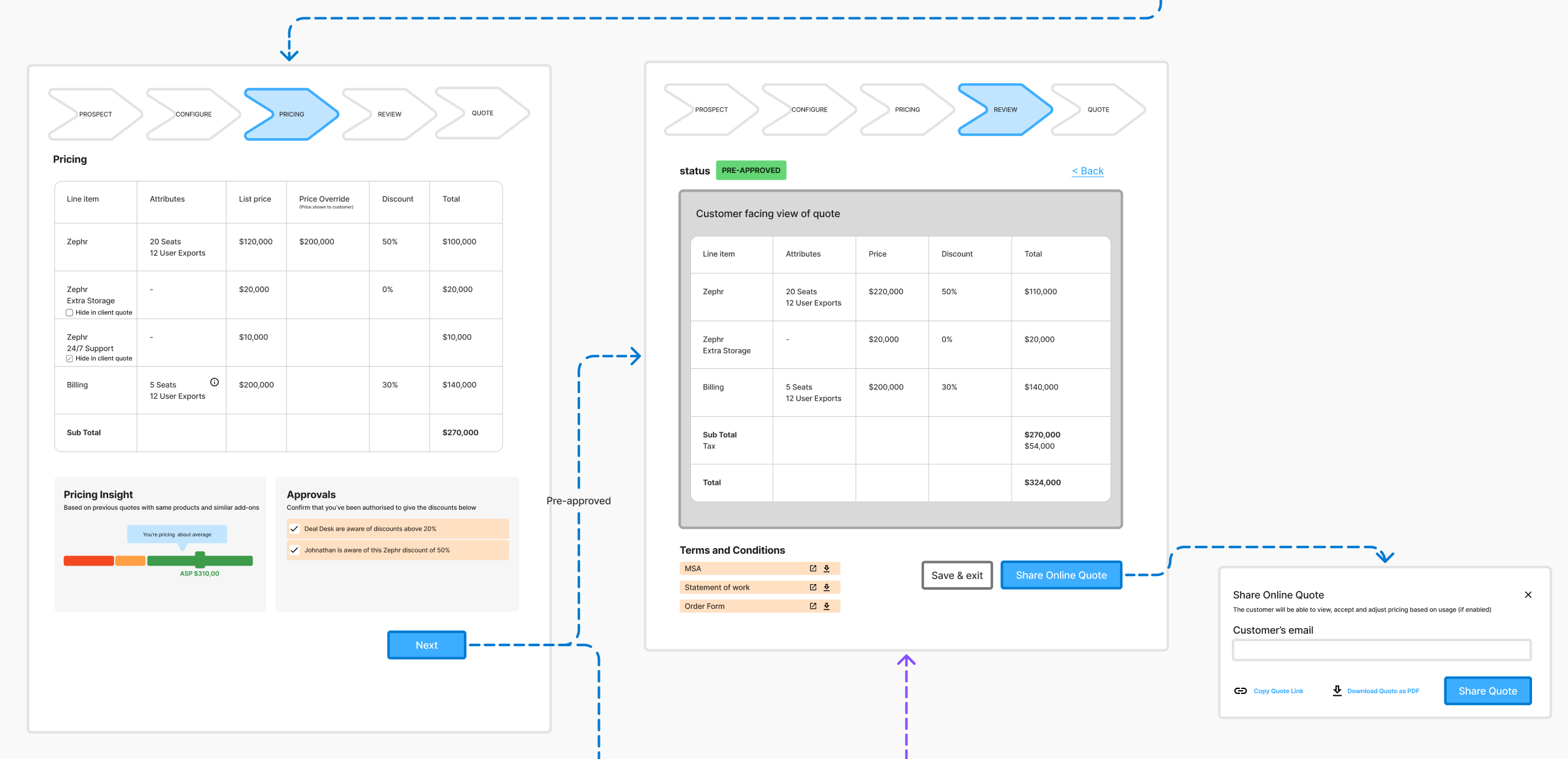
Adding products and assigning attributesUsers found the product selection flow intuitive and fast. However, attribute assignment became difficult for products with 50 or more configuration fields, which showed that the design needed to support higher-density configuration without overwhelming sellers.
Goal seek, pricing insights, and approvalsUsers found approval guidance and pricing insights valuable, but they expected those signals to be visible throughout the workflow rather than only after using goal seek. Goal seek received mixed feedback. Some users valued the speed of working backward from a target value, while others felt the feature added complexity they were unlikely to use.
This feedback also revealed a limitation in the linear stepper: once sellers reached pricing, adding more products became harder than expected. That insight pushed the design toward more flexible navigation within the quote-building flow.
Tested Features: Pricing Guidance (Quickly estimate a quote based on the prospect’s needs)Outcome: Junior/new sales rep found this valubale especially for cold calls, as they could generate estimated
Tested Features: AI Generated QuoteOutcome: Users found this initutive and valuable.
Tested Features: AI Product Configuration - Following the feedback of the posibility product attributes Outcome: Users found this intuitive and valuable. The ability to review the AI-generated quote and continue to build on that got positive reactions.
06 — final solutioN
The phase 1 product
After multiple rounds of testing and prioritization, we defined the first release around the highest-impact workflow improvements: faster quote creation, clearer review of large quotes, better pricing and approval visibility, and AI-assisted support for complex configuration.
The final direction focused on helping sellers move through complex quote-building with more confidence. Instead of exposing every field and decision with equal weight, the experience emphasized clearer information hierarchy, contextual guidance, flexible review, and assistive workflows that reduced manual effort while preserving seller control.
Phase 1 prioritized the areas most likely to improve seller efficiency and quote quality:
- A more guided quote creation workflow
- Better visibility into pricing and approval readiness
- Improved review patterns for large quotes
- AI-assisted quote generation and product configuration
- Stronger guardrails for complex or incomplete quoting paths
07 — Outcomes & impact
Projected Impact
Because the product is planned for release in Q4 2026, impact is currently framed as projected outcomes based on workflow analysis, user testing feedback, and product goals.
speed
30–50% faster quote creation speed
review efficiency
25–40% faster large-quote review efficiency
accuracy
20–30% improvement quote accuracy and policy compliance
Approval readiness
15–25% faster approval readiness
CONFIDENCE
20%+ uplift in Sales Rep’s confidence on complex
deals
AI ADOPTION
40%+ growth in adoption of AI-assisted
workflows
08 — REFLECTION
What I'd do differently
This project helped me shape how Zuora NextGen CPQ could turn enterprise quoting into a more intelligent, contextual workflow. The core design challenge was not simply reducing clicks. It was helping sellers make dense, high-risk commercial decisions feel understandable, controllable, and supported.
If I had more time, I would explore additional opportunities for AI assistance across quote review, pricing recommendations, and error prevention. I would also want to partner with a dedicated UX researcher earlier in the process to go deeper into the many edge cases that shape enterprise quoting. Finally, because some stakeholder decisions changed the direction of the work, I would spend more time documenting tradeoffs and decision rationale so the team could maintain alignment as priorities shifted.
GET IN TOUCH
Let’s work together.
I'm always open to interesting conversations — about design or what comes next.
Ayotunde
© 2026. All rights reserved.
CASE STUDY
Zuora NextGen CPQ
As subscription businesses scale, quoting becomes increasingly complex. Sales teams must configure products, apply pricing rules, manage amendments, and generate accurate quotes while working under time pressure. Zuora NextGen CPQ focused on reducing that complexity by making enterprise quoting easier to understand, faster to complete, and less prone to costly configuration errors.
01 — OVERVIEW
Problem statement & context
Enterprise quoting in Zuora CPQ becomes difficult when scale, time-based changes, and policy complexity intersect. Sellers often manage large, multi-dimensional quotes across ramps, locations, billing accounts, amendments, and future-dated changes. The existing experience exposed this complexity all at once, making quotes difficult to scan, review, and confidently maintain.
This was not just a usability problem. It was a workflow and revenue problem. When quote construction feels dense, slow, or unclear, sellers spend more time navigating the tool, errors become harder to catch, and confidence drops during high-stakes deal work.
Challenge: How might we help sellers understand complex enterprise deals, act on the right information at the right time, and create accurate quotes with greater speed and confidence?
Role: Sole product designer
Team: Product manager, engineering lead, three engineers, and product design support
Timeline: 12 months, planned for Q4 2026 release
02 — DISCOVERY
Understanding the problem space
I began by reviewing recorded customer feedback, support themes, and internal sales pain points using Glean. These inputs helped identify recurring friction across the quoting workflow and shaped the focus areas for user interviews.I then conducted interviews with both Zuora sales reps and customer sales reps to validate assumptions, understand how quoting complexity showed up in real deal work, and define which problems were most critical for the first release.
03 — Synthesis & insights
What we learned
Enterprise quoting breaks down when sellers are asked to manage scale, timing, and policy complexity without enough structure or guidance. Some customers work with hundreds or thousands of quote lines, and that complexity increases further when deals include ramps, multiple locations, or different billing accounts.
At the same time, quote lines contain many fields that are important for billing, provisioning, and compliance, but not always meaningful to the seller during active deal construction. This created a gap between what the system needed and what sellers needed to make progress confidently.
KEY INSIGHT 1
Large quotes become harder to review and maintain when visibility does not scale with quote complexity.
KEY INSIGHT 2
Sellers are exposed to billing-critical fields and system states that are necessary for downstream accuracy but noisy during the selling workflow.
KEY INSIGHT 3
Slow performance and fragile save behavior reduce trust, especially when sellers are working on active deals.
KEY INSIGHT 4
Without stronger guardrails and contextual guidance, sellers can move through invalid or incomplete quoting paths and only discover issues later in the process.
04 — IDEATION & EXPLORATION
How we explored the solution space
To avoid designing around every edge case too early, I started with the simplest quoting scenario: a seller creating a quote for a single product. This helped isolate the core workflow, identify the minimum steps required to complete a quote, and evaluate which interaction patterns could scale.
From there, I gradually introduced more complex scenarios, including product bundles, pricing adjustments, approvals, multiple contracts, and high-attribute product configuration. This incremental approach helped the team test the foundation early while ensuring the experience could support enterprise complexity over time.
Concept A — Guided stepperThis concept moved sellers through distinct stages: product selection, configuration, pricing, and quote review. A persistent sidebar kept the quote total visible throughout the flow, helping sellers stay oriented while completing more structured tasks.
I moved this concept forward because it provided stronger guidance for complex products, reduced the risk of missed steps, and created clearer opportunities to introduce validation, approvals, and contextual assistance.
Concept B — Single-canvas split view
This concept placed product configuration and the live quote side by side on one screen. It supported faster editing because sellers could make changes and immediately see the quote update.While this approach worked well for simpler product catalogs, it became harder to scale for complex products with many attributes, pricing rules, and approval requirements. The team decided it was better suited for lower-complexity workflows than the first release experience.
05 — Prototyping & iteration
How designs evolved through testing
Early prototypes focused on product selection, attribute assignment, pricing guidance, approvals, and multi-contract quoting. Each round of testing helped reveal where the experience needed more structure, more visibility, or more assistance.
Adding products and assigning attributesUsers found the product selection flow intuitive and fast. However, attribute assignment became difficult for products with 50 or more configuration fields, which showed that the design needed to support higher-density configuration without overwhelming sellers.
Goal seek, pricing insights, and approvalsUsers found approval guidance and pricing insights valuable, but they expected those signals to be visible throughout the workflow rather than only after using goal seek. Goal seek received mixed feedback. Some users valued the speed of working backward from a target value, while others felt the feature added complexity they were unlikely to use.
This feedback also revealed a limitation in the linear stepper: once sellers reached pricing, adding more products became harder than expected. That insight pushed the design toward more flexible navigation within the quote-building flow.
Tested Features: Pricing Guidance (Quickly estimate a quote based on the prospect’s needs)Outcome: Junior/new sales rep found this valubale especially for cold calls, as they could generate estimated
Tested Features: AI Generated QuoteOutcome: Users found this initutive and valuable.
Tested Features: AI Product Configuration - Following the feedback of the posibility product attributes Outcome: Users found this intuitive and valuable. The ability to review the AI-generated quote and continue to build on that got positive reactions.
06 — final solutioN
The phase 1 product
After multiple rounds of testing and prioritization, we defined the first release around the highest-impact workflow improvements: faster quote creation, clearer review of large quotes, better pricing and approval visibility, and AI-assisted support for complex configuration.
The final direction focused on helping sellers move through complex quote-building with more confidence. Instead of exposing every field and decision with equal weight, the experience emphasized clearer information hierarchy, contextual guidance, flexible review, and assistive workflows that reduced manual effort while preserving seller control.
Phase 1 prioritized the areas most likely to improve seller efficiency and quote quality:
- A more guided quote creation workflow
- Better visibility into pricing and approval readiness
- Improved review patterns for large quotes
- AI-assisted quote generation and product configuration
- Stronger guardrails for complex or incomplete quoting paths
07 — Outcomes & impact
Projected Impact
Because the product is planned for release in Q4 2026, impact is currently framed as projected outcomes based on workflow analysis, user testing feedback, and product goals.
speed
30–50% faster quote creation speed
review efficiency
25–40% faster large-quote review efficiency
accuracy
20–30% improvement quote accuracy and policy compliance
Approval readiness
15–25% faster approval readiness
CONFIDENCE
20%+ uplift in Sales Rep’s confidence on complex
deals
AI ADOPTION
40%+ growth in adoption of AI-assisted
workflows
08 — REFLECTION
What I'd do differently
This project helped me shape how Zuora NextGen CPQ could turn enterprise quoting into a more intelligent, contextual workflow. The core design challenge was not simply reducing clicks. It was helping sellers make dense, high-risk commercial decisions feel understandable, controllable, and supported.
If I had more time, I would explore additional opportunities for AI assistance across quote review, pricing recommendations, and error prevention. I would also want to partner with a dedicated UX researcher earlier in the process to go deeper into the many edge cases that shape enterprise quoting. Finally, because some stakeholder decisions changed the direction of the work, I would spend more time documenting tradeoffs and decision rationale so the team could maintain alignment as priorities shifted.
GET IN TOUCH
Let’s work together.
I'm always open to interesting conversations — about design or what comes next.
Ayotunde
© 2026. All rights reserved.
CASE STUDY
Zuora NextGen CPQ
As subscription businesses scale, quoting becomes increasingly complex. Sales teams must configure products, apply pricing rules, manage amendments, and generate accurate quotes while working under time pressure. Zuora NextGen CPQ focused on reducing that complexity by making enterprise quoting easier to understand, faster to complete, and less prone to costly configuration errors.
01 — OVERVIEW
Problem statement & context
Enterprise quoting in Zuora CPQ becomes difficult when scale, time-based changes, and policy complexity intersect. Sellers often manage large, multi-dimensional quotes across ramps, locations, billing accounts, amendments, and future-dated changes. The existing experience exposed this complexity all at once, making quotes difficult to scan, review, and confidently maintain.
This was not just a usability problem. It was a workflow and revenue problem. When quote construction feels dense, slow, or unclear, sellers spend more time navigating the tool, errors become harder to catch, and confidence drops during high-stakes deal work.
Challenge: How might we help sellers understand complex enterprise deals, act on the right information at the right time, and create accurate quotes with greater speed and confidence?
Role: Sole product designer
Team: Product manager, engineering lead, three engineers, and product design support
Timeline: 12 months, planned for Q4 2026 release
02 — DISCOVERY
Understanding the problem space
I began by reviewing recorded customer feedback, support themes, and internal sales pain points using Glean. These inputs helped identify recurring friction across the quoting workflow and shaped the focus areas for user interviews.I then conducted interviews with both Zuora sales reps and customer sales reps to validate assumptions, understand how quoting complexity showed up in real deal work, and define which problems were most critical for the first release.
03 — Synthesis & insights
What we learned
Enterprise quoting breaks down when sellers are asked to manage scale, timing, and policy complexity without enough structure or guidance. Some customers work with hundreds or thousands of quote lines, and that complexity increases further when deals include ramps, multiple locations, or different billing accounts.
At the same time, quote lines contain many fields that are important for billing, provisioning, and compliance, but not always meaningful to the seller during active deal construction. This created a gap between what the system needed and what sellers needed to make progress confidently.
KEY INSIGHT 1
Large quotes become harder to review and maintain when visibility does not scale with quote complexity.
KEY INSIGHT 2
Sellers are exposed to billing-critical fields and system states that are necessary for downstream accuracy but noisy during the selling workflow.
KEY INSIGHT 3
Slow performance and fragile save behaviour reduce trust, especially when sellers are working on active deals.
KEY INSIGHT 4
Without stronger guardrails and contextual guidance, sellers can move through invalid or incomplete quoting paths and only discover issues later in the process.
04 — IDEATION & EXPLORATION
How we explored the solution space
To avoid designing around every edge case too early, I started with the simplest quoting scenario: a seller creating a quote for a single product. This helped isolate the core workflow, identify the minimum steps required to complete a quote, and evaluate which interaction patterns could scale.
From there, I gradually introduced more complex scenarios, including product bundles, pricing adjustments, approvals, multiple contracts, and high-attribute product configuration. This incremental approach helped the team test the foundation early while ensuring the experience could support enterprise complexity over time.
Concept A — Guided stepperThis concept moved sellers through distinct stages: product selection, configuration, pricing, and quote review. A persistent sidebar kept the quote total visible throughout the flow, helping sellers stay oriented while completing more structured tasks.
I moved this concept forward because it provided stronger guidance for complex products, reduced the risk of missed steps, and created clearer opportunities to introduce validation, approvals, and contextual assistance.
Concept B — Single-canvas split view
This concept placed product configuration and the live quote side by side on one screen. It supported faster editing because sellers could make changes and immediately see the quote update.While this approach worked well for simpler product catalogs, it became harder to scale for complex products with many attributes, pricing rules, and approval requirements. The team decided it was better suited for lower-complexity workflows than the first release experience.
05 — Prototyping & iteration
How designs evolved through testing
Early prototypes focused on product selection, attribute assignment, pricing guidance, approvals, and multi-contract quoting. Each round of testing helped reveal where the experience needed more structure, more visibility, or more assistance.
Adding products and assigning attributesUsers found the product selection flow intuitive and fast. However, attribute assignment became difficult for products with 50 or more configuration fields, which showed that the design needed to support higher-density configuration without overwhelming sellers.
Goal seek, pricing insights, and approvalsUsers found approval guidance and pricing insights valuable, but they expected those signals to be visible throughout the workflow rather than only after using goal seek. Goal seek received mixed feedback. Some users valued the speed of working backward from a target value, while others felt the feature added complexity they were unlikely to use.
This feedback also revealed a limitation in the linear stepper: once sellers reached pricing, adding more products became harder than expected. That insight pushed the design toward more flexible navigation within the quote-building flow.
Pricing guidanceJunior and newer sales reps found pricing guidance especially useful during early discovery calls because it helped them estimate pricing while listening to a prospect’s needs. More experienced reps felt less dependent on this support because they already had stronger intuition around pricing.
This helped clarify that pricing guidance should support confidence without slowing down expert users.
AI-generated quoteUsers responded positively to the ability to generate an initial quote with AI, review the output, and continue refining it manually. This positioned AI as a starting point for faster quote creation rather than a black-box replacement for seller judgment.
AI-assisted product configurationAfter testing showed that high-attribute products were difficult to configure manually, we introduced AI-assisted configuration. Users found this valuable because it reduced the effort required to translate customer needs into product settings while still allowing them to review and adjust the final configuration.
06 — final solutioN
The phase 1 product
After multiple rounds of testing and prioritisation, we defined the first release around the highest-impact workflow improvements: faster quote creation, clearer review of large quotes, better pricing and approval visibility, and AI-assisted support for complex configuration.
The final direction focused on helping sellers move through complex quote-building with more confidence. Instead of exposing every field and decision with equal weight, the experience emphasised clearer information hierarchy, contextual guidance, flexible review, and assistive workflows that reduced manual effort while preserving seller control.
Phase 1 prioritised the areas most likely to improve seller efficiency and quote quality:
- A more guided quote creation workflow
- Better visibility into pricing and approval readiness
- Improved review patterns for large quotes
- AI-assisted quote generation and product configuration
- Stronger guardrails for complex or incomplete quoting paths
07 — Outcomes & impact
Projected Impact
Because the product is planned for release in Q4 2026, impact is currently framed as projected outcomes based on workflow analysis, user testing feedback, and product goals.
speed
30–50% faster quote creation speed
review efficiency
25–40% faster large-quote review efficiency
accuracy
20–30% improvement quote accuracy and policy compliance
Approval readiness
15–25% faster approval readiness
CONFIDENCE
20%+ uplift in Sales Rep’s confidence on complex
deals
AI ADOPTION
40%+ growth in adoption of AI-assisted
workflows
08 — REFLECTION
What I'd do differently
This project helped me shape how Zuora NextGen CPQ could turn enterprise quoting into a more intelligent, contextual workflow. The core design challenge was not simply reducing clicks. It was helping sellers make dense, high-risk commercial decisions feel understandable, controllable, and supported.
If I had more time, I would explore additional opportunities for AI assistance across quote review, pricing recommendations, and error prevention. I would also want to partner with a dedicated UX researcher earlier in the process to go deeper into the many edge cases that shape enterprise quoting. Finally, because some stakeholder decisions changed the direction of the work, I would spend more time documenting tradeoffs and decision rationale so the team could maintain alignment as priorities shifted.
GET IN TOUCH
Let’s work together.
I'm always open to interesting conversations — about design or what comes next.
Ayotunde
© 2026. All rights reserved.