Product
Decide which products or product sets are eligible.
Designing a modular experience for creating, previewing and launching subscription offers without relying on engineering for every change.
uplift in new-business conversion
uplift in add-on conversion
revenue lift from personalisation
Subscription businesses need different offers for different audiences. Pricing, packaging, discounts, and messaging depend on intent, engagement, lifecycle stage, location, and content context.
Traditional offer systems can turn each experiment into engineering work. I led the design of a rules-driven experience that let business teams assemble contextual offers while keeping the output connected to Zuora Billing.
A limited set of standard and premium plans cannot fit every customer’s needs, budget, or perception of value.
The product direction: use first-party context to assemble a more relevant product proposition for each audience.
Lead Product Designer
Offer configuration and decision clarity
PM + 3 engineers
1 frontend and 2 backend engineers
3 months to MVP
A focused first release
Help growth teams configure context-aware offers, understand which rules influence the outcome, and trust the result before launch.
The product had to orchestrate more than a price. I explored a modular rule-builder on top of Zephr’s no-code decision engine, breaking the offer into product, price, discount, tagline, and custom properties.
Context such as session data, location, device, authentication state, and customer-defined inputs can influence each decision. Making those relationships understandable became central to the experience.
Customer UI → Dynamic Offers rules → Configuration details.
Decide which products or product sets are eligible.
Select price points associated with those products in the billing catalog.
Layer in acquisition, seasonal, or win-back promotional logic.
Use tagline and custom-property rules to shape labels, copy, imagery, or badges.
The modular model separates each commercial decision while keeping it part of one offer. These recordings follow the setup from eligible products through price, discount, messaging, and preview.
The product rule establishes which products or product sets can be returned for a visitor. Its output gives the later pricing and promotional rules a clear starting point.
Configure product outputs and the conditions that determine eligibility.
Keep the product decision focused so teams can reason about eligibility before working through price and presentation.
Once a product is eligible, price rules choose from the associated price points in the billing catalog. Contextual conditions shape which price is returned while the commercial data stays connected to Zuora Billing.
Build contextual price logic with filters, conditions, and price outputs.
Make the relationship between context and price visible, while using catalog-defined prices rather than disconnected frontend values.
Discount rules apply promotional logic after product and price selection. This supports acquisition incentives, seasonal offers, and win-back strategies within the same decision model.
Configure promotional outputs and the conditions under which a discount applies.
Separate promotional decisions from base pricing so teams can understand what is being offered and why.
Tagline and custom-property rules shape how the resolved offer is presented. They can influence supporting copy, labels, badges, imagery, and other elements of the customer-facing experience.
Configure a tagline output and contextual conditions for the offer’s messaging.
Keep commercial logic and presentation related, while giving each a focused place to be configured.
The preview flow lets teams choose the offer version, define visitor criteria, and inspect the resulting response. The recording shows criteria such as authentication state and country alongside the selected offer output.
Set preview criteria and review the offer response.
Make rule behaviour inspectable in a defined context so teams can review the outcome before putting it into a customer journey.
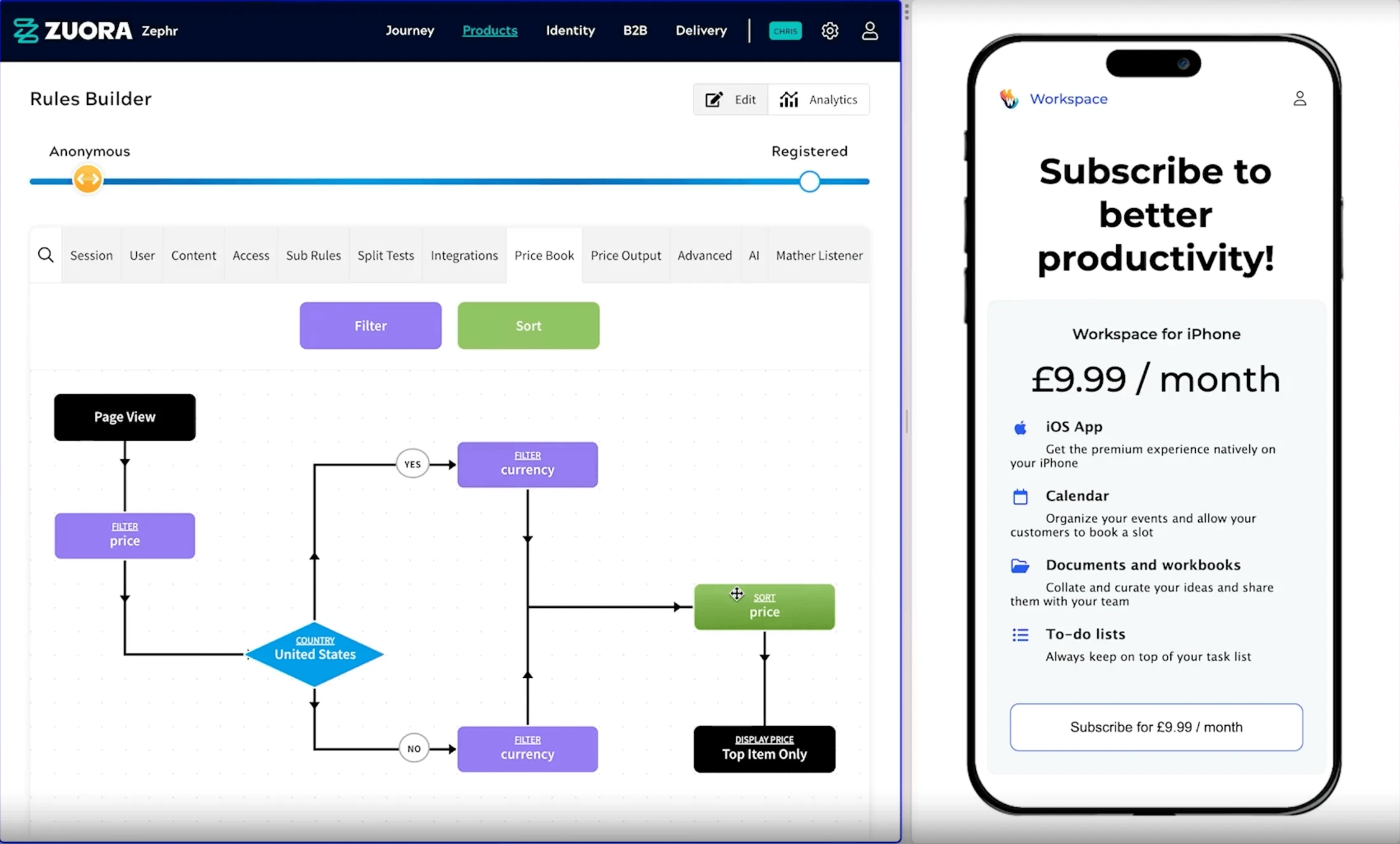
The live walkthrough pairs the decision engine with a customer-facing subscription experience. As the configured context and rules change, the rendered plan, price, or message shows the result.
Full walkthrough: decision rules alongside the resulting subscription offer.
The website receives a structured offer response and renders the experience. Conversion events can then be sent through the conversion API to inform future offer strategies.
Configure pricing, packaging, promotions, and messaging through a shared system rather than bespoke frontend changes.
Receive a structured offer payload connected to billing catalog price points.
Uplift in new-business conversion.
Uplift in add-on conversion.
Uplift in free-to-paid conversion.
Revenue lift from personalised experiences.
Increase in marketing return on investment.
The project moved from concept to MVP in three months. With more time, I would invest further in understanding how businesses currently plan and manage offers.
Allocate more time to user research within a fast-moving project.
Go deeper into how businesses plan, configure, and manage their offers today.
I’m always open to interesting conversations—about design or what comes next.